Showing posts with label Teachers. Show all posts

Thursday, November 20, 2008

Downtime

+14:00 Zwedru~

It has become obvious that life in Liberia is vastly different than the high-speed, must-do-it-yesterday life Americans have grown to love (or loathe). This fact becomes more apparent with each passing moment out here. Today was another example of this divergence from American life.

We couldn't send word to Pyne Town, which is in Sinoe County, of our impending visit. This, in turn, prevents us from travelling out there since we wouldn't reach the school in time to visit the children before they are dismissed. Sending word allows the teachers to delay releasing the children for the extra half-hour. As such, we opted to return to Nixon School today.

Students were continuing their 2nd Period testing today. Testing here is not like America. You don't sit in a classroom and have the teacher hand out the exams and then continue on with the day after the exam is finished. Instead, each subject teacher uses a specific classroom to administer the test. The teacher will then write the exam on the blackboard. The students, during their appointed hour, will arrive to the classroom, receive a blank piece of paper (with the school's seal stamped in the corner), and begin their examination. No student is allowed to enter or leave during the exam, either.

Because of this, the classes are staggered for their exam schedule. The lower grades, 2nd through 5th grade for example, will arrive on one day for their exams followed by the upper grades the next day. This will go on for a week, beginning on Wednesday and finishing on Tuesday the following week.

Because there was not much to do today, I thought I'd take the time to talk more in depth about the food. If you want to eat in Liberia know one simple fact; you will eat rice ever day you are there. If you do not like rice one bit, there is little chance you will enjoy anything in this country. Fortunately for me, I enjoy rice quite a bit.

The concept of three square meals, or six small meals as many nutritionists will tell you is healthier, is lost in this nation. Instead, you have one large meal prepared for the day. It is typically served in the early afternoon. There will be a large dish of rice accompanied with a smaller dish of some type of "sauce." The sauce is the excitement for each meal. Everything I have had so far has been amazing. We've enjoyed a peanut sauce with beef, "greens" with duiker, potatoes with fish, and cassava with chicken. Everything is spicy and filled with exotic flavor. Especially the cassava. I think this is my favorite so far. It is funny because I don't like tapioca, which is made from the root of the cassava plant.

Cassava is an interesting plant. As I said, the dish was filled with flavor and spicy. There was a thickness to the texture of the dish, with the sauce saturating each grain of rice to ensure a dish filled with flavor. I wish I could compare it to a familiar dish, but unfortunately I cannot. I can say it is interesting to note if the cassava leaf is not cooked properly it can make you violently ill and consumption of the raw leaf can kill you. The leaf contains a chemical that leads to the creation of cyanide.

As I mentioned earlier, the meal is prepared in the early afternoon. Everyone will eat as soon as the dish is ready, but no one puts away the food afterwards. Since there is no central source of electricity, there is no concept of refrigeration or food storage. Instead, you leave the meal covered for the day and eat whenever you are hungry. Typically, Liberians eat twice daily.

Further, meals are not a family affair. The men will eat separate from the women and children. Men will sit in front of the home, talking about the topics of the day while the women and children eat in the back, near the preparation area. I'm not sure what they talk about, if anything, since I was never back there during a meal.

When we were in Zleh Town, the pastor of Trinity Lutheran invited us to visit his home. This, it turns out, means he wanted to serve us a meal. We sat in the main room, where the pastor's mother dished us the food, first with the rice in the bowl and then the sauce on top. This was the "greens" I had mentioned earlier. Now, this dish sounds bland, but it was by far the spiciest meal I had all week. If it weren't for 1.5L bottles of water, I don't think I could've lasted throughout the meal. Greens, in Liberian, mean the leaves of the potato finely chopped and served with oil, typically palm oil, and meat. As you can guess, I had never had the leaf of a potato before. Tastes pretty good if you ask me.

As soon as the woman served our dishes, she disappeared. We were left to eat alone and only saw her again after we had finished so she could collect the dishes and disappear again. The roles of men and women in this society are very defined and rarely blurred. Even when guests arrive, the men and women do not eat together. It was not uncommon for a woman to greet me, talk for a moment and then disappear to the back to eat while the men stayed up front.

I asked Joe about this later, and he said this was how the culture exists. It is a regimented division between the men and the women. He had mentioned it can lead to problems, especially in dating. I wasn't able to ask much more, but he touched on it briefly, stating that the couple will often be separated from each other during the date because of the requirements.

Somehow, I don't see how many young Americans, myself included among them, would find this aspect of Liberia culture enjoyable.

Monday, November 17, 2008

Ah, The Children

+15:00 Zwedru~

Last night's venture into the neighborhood prepared me well for today's visit to the school. Joe had some photos of the neighborhood children he wanted to hand out and I wanted to take some shots of my surroundings. When the children caught sight of my camera, which isn't small, the photos of the homes and people acting naturally became an impossibility.
Instead, I was able to talk with a dozen or so children, all wanting their picture taken. As I would finish taking pictures, they would then try to touch my hand or my arms, before they started screaming in joy at seeing their photos through my viewfinder. It was entertaining to see so many kids laugh at their very image, as if they were movie stars now because of a camera.


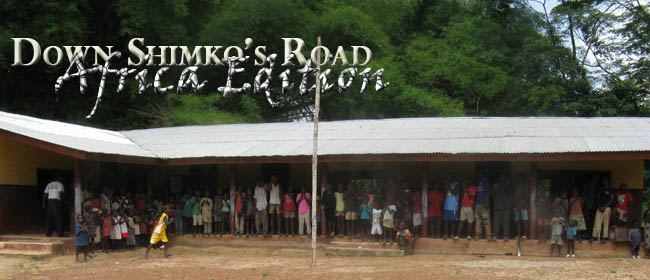
This morning I visited my first school, Nixon Elementary and Junior High School, named after the man who donated the land. The children were no different than the night before. During recess, they would all come in droves, typically the smaller children, for an opportunity to shake my hand, touch my arm, look at my legs (more specifically the two cross tattoos) and have their pictures taken. One girl walked up to me and hugged my legs.

The school is interesting and nothing from what I expected. They study the same subjects as the rest of the world - math, science, English, social studies, etc. - but they don't have classes in the same manner. Each grade has one classroom. This means some classes are sparsely populated, such as the ninth and tenth grades, while others are packed in tightly with five or more to a bench, as is the case for kindergarten and pre-school. What amazes me the most about the larger classrooms is not how the children don't mind having to study in such cramped quarters, usually for five hours daily. It is how these are the classes where the teachers do not switch out every hour for a new classroom.

In the higher grades, second grade on up, the teachers teach one subject and then move to another classroom to teach. It's like high school, but in reverse. This is not the same for pre-school (known as ABC in Liberia) up through first grade. These classes, four in total since kindergarten is split into two levels, have one teach for the entire day. The students, packed into small, 10x10 rooms, have to endure the heat in a room with no fans while the teacher tends to the students, many of who may be sick from malnutrition or germs or any of a dozen other ailments that small children are afflicted with daily.

This isn't meant to shed a dark light on what is happening. Rather this is to praise what the teachers are doing daily. They teach, day-in and day-out, without the same pay as the others, without the opportunity to take a thirty-minute break in the day like the others, and without the same gratitude shown to the others. They take on the role of the surrogate mother - in a culture where the younger children are not cared for the same way as the older, in fact many children in the poorer villages are without clothes because the family would spend their money on clothing for the older sons and daughters.

This is why Joe spends more time working with these teachers and striving to provide resources for these classes than he does the other grades. The new building coming in for this school will be geared for the ABC to first grade classes. It will provide much-needed space for the students to learn, with an area where teachers can read to the students, with the books provided by Mike's friend (Mike is one of the four members of the team mentioned a few weeks ago) to start. It is a great beginning for many of these children, with more potential for success as they grow older.

I had mentioned the older classes have more space, but this does not equate to easier methods of learning. The schools all across the country have little money, and that means limited resources. There are no textbooks handed out at the beginning of the school year. Instead, the teacher lectures the students and provides notes on a blackboard, with the students taking meticulous notes (and drawings - I saw one student's work and his diagram of a chemical compound accompanied by a drawing of a Bunsen burner with its properties put me to shame).

These children are not here because they have to be here. Rather, these children are here because they want to be here. They want to get an education. Their dedication to school rivals many American children's dedication. I still have much more to see, but I think the future of this war-battered nation could bring great success if more children took the opportunity to receive a decent education.

Not everything is working in their favor, however. The Liberian government and the United Nations, from what I've seen, have become more of a hindrance than a help to the redevelopment to this nation. They throw money at the problem, but don't give Liberians anything to support themselves. It's like giving a child a fish. If you don't teach that child how to fish, he'll rely on you for the rest of his life. This nation has no real project aimed at helping the Liberians, but they collect taxes to provide a basic function. There are police, but I didn't see many unless I was at an immigration check point or in Monrovia. Little money goes to education or public works, competition is rare and many people are left waiting for someone to come in to help.

Power plants were destroyed during the war, but the government doesn't take any real action to rebuild them because they want to see if another organization (see: UN or USAID) will step in first. This not only prevents progress in this country, but makes a mockery of the oldest republic in Africa. I hope the children I met today, and those I will see as my time continues, will have an opportunity to turn this around and turn Liberia into a nation that can support itself without the help from the UN or the WHO, or any other organization.