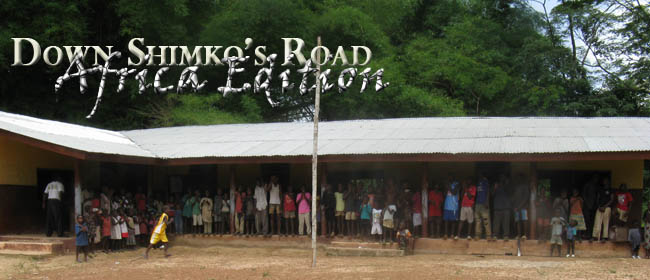
 I revisited Nixon School today. The classrooms are filled with wonderful children with highly inquisitive minds. Joe and I met with each classroom this morning, but this time it was for me to talk to them a bit and to answer whatever questions they may have. I spoke a little about where I am from, and thanked them for affording me some time to talk to them. Then the floor was open for questions. Some were the usual questions you would expect to hear, while others were a little harder to answer.
 The students, as well as the teachers and any other person I've ran into, wanted to know what I did for a living - which isn't really easy to answer when you are in a country who doesn't have researchers or analysts or political workers. The other questions would flow at nearly the same time in each classroom; am I married, do I have kids, where do I live in America? When they  found out how old I was, the classroom would erupt in laughter. Not because it was strange to have a 28-year-old visit them, but because they didn't expect someone so young to be done with high school and college. Some of the kids in the higher grades were near my age.
 found out how old I was, the classroom would erupt in laughter. Not because it was strange to have a 28-year-old visit them, but because they didn't expect someone so young to be done with high school and college. Some of the kids in the higher grades were near my age.
 When we moved to schooling, the real differences between schools in Liberia and America were revealed. They were surprised to hear that I would be the one who had to move between classrooms for each subject, and they thought it was amazing that I didn't have to take the meticulous notes they did because I had textbooks.
While those questions were fun to answer and enjoyable to discuss, others were hard to find the right response. Each class from fifth grade to tenth grade had at least one student who wanted to know what I could do for them. Some thought I was a missionary or pastor who arrived to give money or build a school. None could understand that I was just a visitor (more on that in a second) who came to witness the work being done.
 These children aren't asking this question because they want something from me. They are asking it because various organizations - namely USAID, UNMIL (UN Mission in Liberia), and the EU - are trying to help but at a detriment to Liberia. They hand out money (as I mentioned earlier) but don't hand out opportunities to learn. The churches and other non-government organizations are doing great work but they can only go so far. Their funding is limited and their reach is restricted by the poor road conditions throughout the country (more on that in a few days). More is needed so people won't grow up asking how will you help me and start asking what can we do to help ourselves.
 Because of this situation, when I brought the money raised from St. Mark's, we didn't tell them it came from me or that I brought the money. Instead, Joe would explain that Americans who care about what is going on through the Liberian Children's Ministry have provided the funding necessary to build two new school buildings and add on to another school (the money I brought from the church provided the half of the funding). This way, when others come to visit, they will not expect anything similar because I didn't bring the money, but the organization raised the money.
On another note, last night was fun. Joe, the Dweh's (the pastor and his family) and a couple of other visitors sat outside all night and talked. Most of it was Joe talking about America since he can understand them better than I and speaks their dialect much easier than I could ever imagine speaking. Every time Joe would mention something mundane for us (mowing the lawn or taking the trash out), they would be amazed at America's lifestyle. Then whenever Joe talked about an aspect of American life, they would be amazed at how much we could have and how much more we wanted.
Not only was it interesting to see how two cultures try to understand each other, it was also eye-opening to realize how little we really need to get by in America. There is no power here in the daytime, and only at night if the family can afford the fuel. There is no running water, nor indoor plumbing for most. No X-Box, TVs, DVDs, sports cars (or cars unless it is a government vehicle or taxi), decorations, sound systems, or any other kind of toy. Instead, there is the family, a roof, food to eat and a means to help other friends or family. I'm amazed at it all, but also thankful for what I have been blessed to have.


